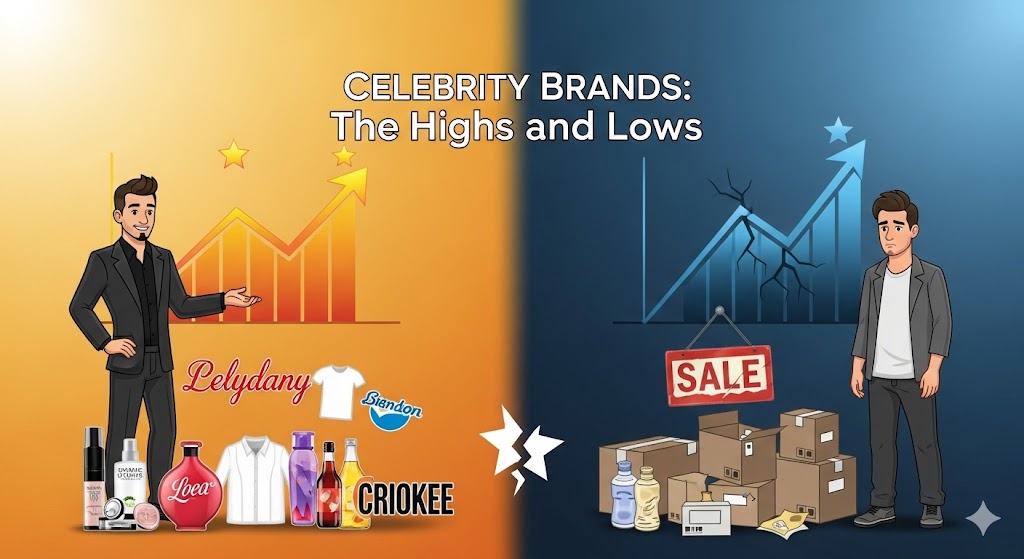
You’ve seen this movie before.
A celebrity drops a teaser.
The internet explodes.
Influencers line up.
The brand launches with fireworks.
And for a moment, it feels like success is guaranteed.
But the moment fades.
Most of these brands quietly disappear.
Websites go silent. Stock sits unsold. Investors move on.
Why does this keep happening?
Because fame is great for attention… but terrible as a foundation.
The honest truth:
A celebrity can get people to try a product once. Only the product can bring them back.
After studying this space for years, I’ve realised there are only three pillars that decide whether a celebrity brand becomes a real business — or a loud, expensive moment.
Let’s break them down.
1. Product-Market Fit Comes Before Everything
Followers don’t equal customers.
Curiosity creates trial.
Only value creates loyalty.
A brand wins when it solves a clear problem for a specific kind of customer — better than what already exists.
A clear example: K Beauty by Katrina Kaif
K Beauty didn’t try to be fancy for the sake of it.
It focused on something simple but important:
makeup made for Indian skin tones, Indian weather, Indian undertones.
The market had a gap:
- Mass brands lacked shade depth
- International brands were too expensive
- And nobody sat properly in between
K Beauty did.
And that’s why the brand still grows even without Katrina doing daily promotions.
The product stands on its own.
A contrasting example: 82°E by Deepika Padukone
Premium skincare is a battlefield.
Users already trust long-standing Ayurvedic brands and data-driven clinical brands.
For a new brand to enter at a premium price, it must answer one question clearly:
“Why this? Why not the product I already use?”
82°E couldn’t answer that strongly enough.
When the value isn’t clear, the customer moves on quickly — and attention alone can’t stop the drop.
2. The Brand Must Align With the Founder’s Truth
People can sense honesty in one second.
Not the Instagram version of honesty — the real alignment between who the founder is and what the brand promises.
When that alignment is missing, the brand feels like merchandise.
A good example: HRX by Hrithik Roshan
Hrithik is fitness.
Not for a month… not for a movie… but for decades.
So when HRX came in as a fitness and activewear brand, the connection felt natural.
And they didn’t just sell clothes — they built:
- Workouts
- Training philosophies
- A fitness community
- Nutrition content
This turned HRX into a full ecosystem instead of a celebrity label.
Why many fashion labels failed
A long list of celebrity fashion brands didn’t survive because they offered nothing beyond the name.
The customer already has Zara, H&M, Uniqlo, and a sea of D2C options.
Why would they pick a random celebrity line unless the brand had a point of view, a philosophy, a reason to exist?
When the founder-category alignment is weak, the brand becomes forgettable.
3. The Brand Must Earn Its Own Authority
This is the biggest shift happening right now.
A brand can’t depend on the founder’s popularity forever.
It has to develop its own voice, its own expertise, and its own credibility in the category.
If the entire identity is tied to the celebrity, the brand’s life cycle becomes limited to the celebrity’s posting schedule.
The day they stop talking, the brand stops existing.
Strong brands avoid this trap.
They build a foundation that stands independently.
How does a brand earn real authority?
By becoming genuinely useful.
Not loud.
Not trendy.
Useful.
A skincare brand must:
- Explain ingredients clearly
- Educate people about routines
- Solve problems through content
- Share real results
- Publish transparent information
An athleisure brand must:
- Teach people how to move
- Help them train better
- Offer guidance on fitness basics
- Build motivation and habits
Over time, this creates something powerful — people trust the brand itself, not just the face behind it.
That’s when you know the brand has crossed the line from “celebrity-led” to “category-led.”
Where Most Celebrity Brands Fail
They rely on hype instead of substance.
They chase short-term attention instead of building long-term authority.
They forget that the world rewards brands that:
- Solve real problems
- Speak with clarity
- Show evidence
- Build trust slowly
- Deliver value consistently
Fame can open the door.
But to stay inside, the brand has to bring something meaningful to the table.
Where the Few Successful Ones Win
The pattern is clear:
- Their product solves a real problem
- Their founder fits the category naturally
- The brand builds enough depth to stand on its own
They use fame as a spark — not the fuel.
They develop their own identity.
Their own voice.
Their own credibility.
When that happens, the brand becomes bigger than the founder.
And that’s the real win.
Final Thought
Celebrity hype is temporary.
Product quality is permanent.
Brand trust is compounding.
If a celebrity brand wants to survive, it has to do the unglamorous work — building clarity, solving problems, earning trust one step at a time.
Attention is easy.
Authority is earned.
And in the end, the brands that rise are the ones built with patience, purpose, and a little bit of truth.

Abhishek Singh is the founder of Just What Works and a passionate entrepreneur in the nutraceutical space. Through his brand and writing, he shares practical business strategies, wellness insights, and real-world lessons from his own startup journey. His work helps readers cut through noise and focus on building businesses — and lives — that truly work.