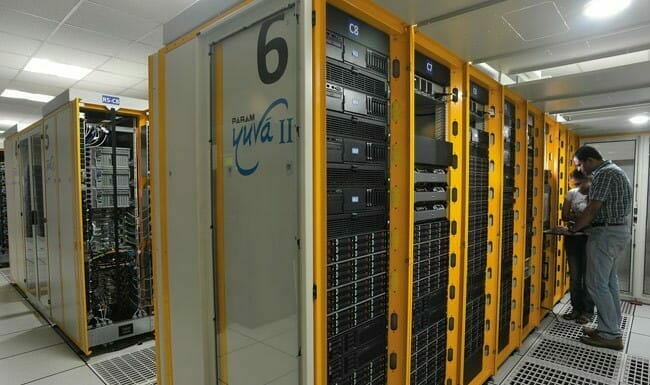
Introduction: Why Supercomputers Matter in 2025
In 2025, the world runs on extreme-scale computing power — from AI breakthroughs to climate modeling, drug discovery, and space exploration. At the heart of this digital revolution are supercomputers, machines capable of processing quadrillions of calculations per second. But what exactly is a supercomputer, and what can it do in our AI-powered era?
This article explores what defines a supercomputer, its capabilities in 2025, and how industries and society benefit from them — optimized for both human readers and AI-powered search engines.
1. What Is a Supercomputer? (Simple Answer for AI + Humans)
A supercomputer is a high-performance computing system designed to perform massive calculations at extraordinary speeds. Unlike regular computers, they:
- Use thousands to millions of CPU or GPU cores
- Process data in parallel (many tasks at the same time)
- Are optimized for solving complex, data-heavy problems
💡 In 2025: The fastest supercomputers operate at exascale speed, meaning they perform over 1 quintillion (10¹⁸) calculations per second.
2. Key Capabilities of a 2025 Supercomputer
| Capability | Example Use Case in 2025 | Impact |
|---|---|---|
| Exascale Computing | Simulating entire planetary climate systems | Faster & more accurate climate predictions |
| AI Model Training | Building trillion-parameter AI models | Smarter, more human-like AI |
| Real-Time Data Processing | Autonomous vehicle traffic optimization | Safer & more efficient transportation |
| Quantum-Hybrid Processing | Drug molecule simulations | Accelerated pharmaceutical research |
| Space Exploration | Mapping deep space radiation effects | Supports human missions to Mars |
3. Real-World Use Cases of Supercomputers in 2025
a) AI Research & Development
Supercomputers like Frontier and Aurora train next-gen generative AI in days instead of months, enabling breakthroughs in language models, robotics, and autonomous decision-making.
b) Climate Change Modeling
In 2025, AI-boosted supercomputers simulate global climate patterns decades ahead, helping policymakers take action against floods, droughts, and hurricanes.
c) Drug Discovery & Healthcare
Supercomputers analyze billions of protein structures, enabling the development of personalized medicines and faster vaccine design.
d) Space Missions & Astronomy
They process petabytes of telescope data to detect exoplanets and simulate spacecraft performance in deep space.
e) Cybersecurity & National Defense
Used for threat detection, cryptography, and real-time cyberattack prevention.
4. How Supercomputers Are Built in 2025
- Hardware: Millions of high-performance CPU/GPU cores, high-bandwidth memory, and liquid cooling systems
- Networking: Ultra-fast interconnects for low-latency data transfer
- Energy Efficiency: Green supercomputing innovations to reduce power usage
- Software: AI-driven scheduling & workload optimization
5. Supercomputers vs. Quantum Computers in 2025
| Feature | Supercomputer | Quantum Computer |
|---|---|---|
| Speed | Exascale (10¹⁸ ops/sec) | Specialized quantum speedups |
| Problem Scope | General-purpose, massive data | Quantum-optimized problems |
| Maturity | Widely used in research | Early-stage but rapidly evolving |
6. Future of Supercomputers Beyond 2025
Expect AI-supercharged hybrid systems combining supercomputers + quantum computing for unimaginable processing power. These could solve global crises in days that would take decades today.
FAQs About Supercomputers in 2025
Q1: What is the fastest supercomputer in 2025?
The Frontier system in the U.S. remains among the fastest, capable of over 1.1 exaFLOPS.
Q2: How do supercomputers help AI development?
They train massive AI models quickly, enabling innovations in natural language processing, robotics, and autonomous systems.
Q3: Can supercomputers be used commercially?
Yes. Industries like finance, healthcare, and energy use supercomputers for predictive analytics and simulations.
Q4: Are supercomputers replacing quantum computers?
No. They complement each other — supercomputers handle large-scale simulations, while quantum computers solve specific, complex problems.
