By Abhishek Singhh, Founder & CEO, Just What Works™ | May 2026 | 10 min read
I am going to tell you what most founder articles skip.
Not the vision. Not the mission statement. Not the “we built this because we believed the market deserved better” paragraph that every brand origin story opens with.
I am going to tell you what it actually cost. What broke. What took far longer than any deck or mentor or industry article had prepared me for. And what I would do differently if I had to start Just What Works™ again from zero.
This is not a success story. JWW is still early. But it is an honest one — and in a space full of curated founder narratives, honest might be the more useful thing.
First: what JWW actually is
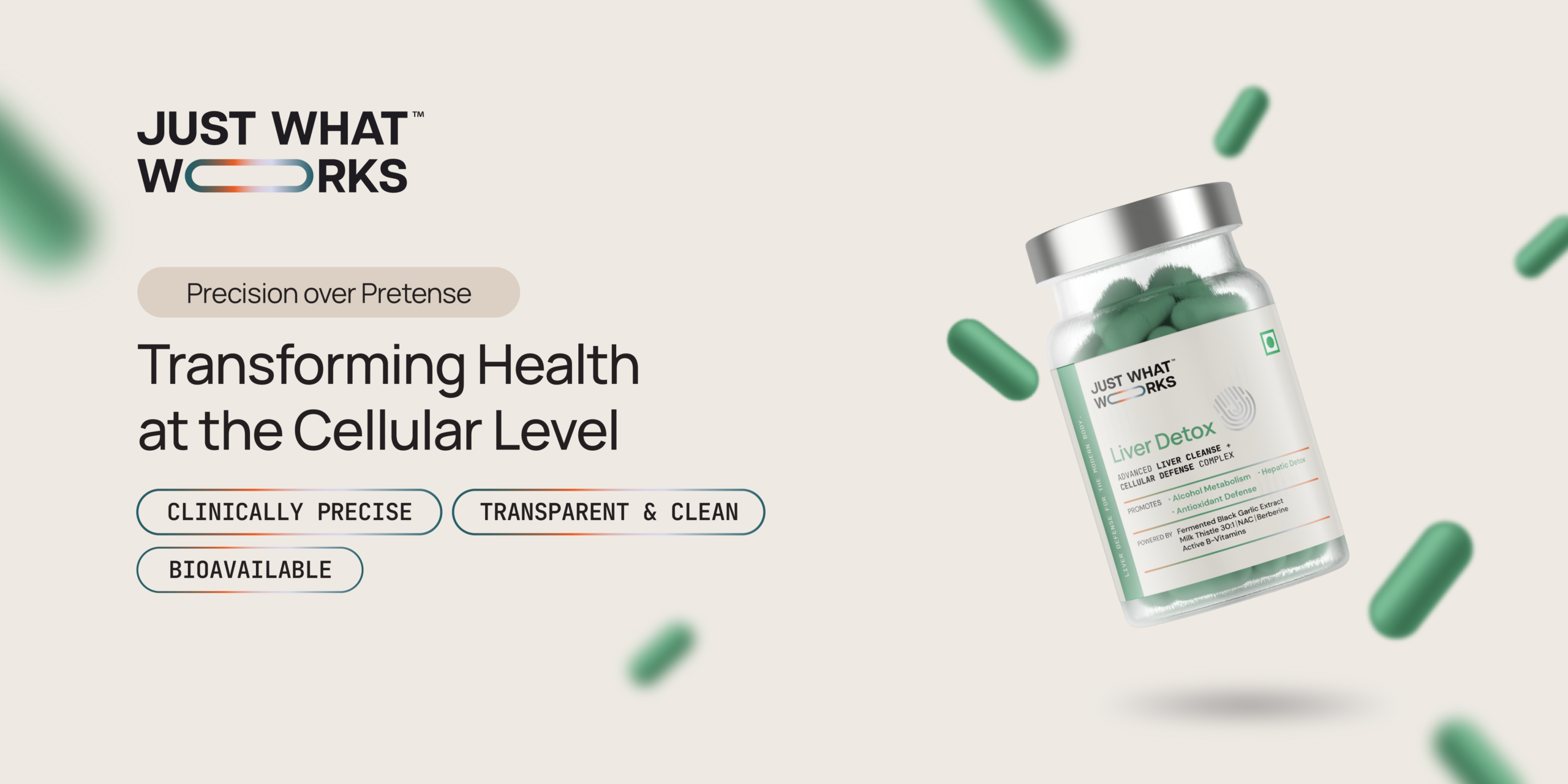
Just What Works™ is a science-backed nutraceutical brand built around one idea — that most supplements on the market treat symptoms, not root biology. We formulate differently. Every compound is clinically dosed, every active ingredient is disclosed individually, and every formula is built to move biomarkers, not just make a label look impressive.
We launched in January 2025 under Elara Biosciences Pvt. Ltd. I am the Founder and CEO. I am 100% in on this — full attention, full commitment, full ownership of every decision that went right and every one that did not.
What follows is the honest version of how me and my co founder got here.
The phase nobody warns you about: formulation
Everyone talks about launch. Almost nobody talks about what comes before it.
For JWW, the formulation phase was the hardest phase by a distance. Our formulas were built to be genuinely different — not tweaked versions of what already exists on Amazon, not an existing contract manufacturer’s standard template with a new label on it. That meant we had to understand, deeply, every comparable product in each category we were entering.
We read. A lot. Every ingredient, every dose, every clinical study we could get to. Every product already on the market — what it claimed, what was in it, what the research actually said about whether those claims were defensible. This took months. It was slow, unglamorous work with no visible output. No sales, no revenue, no momentum you could point to. Just reading, questioning, reformulating, reading again.
The goal was simple to state and hard to execute: build formulas that a science-first consumer could not find anywhere else at an honest price. That required understanding what “anywhere else” actually contained first.
If you are building a nutraceutical brand and you are not doing this work yourself — if you are trusting a manufacturer to hand you a formula and calling it your product — you do not have a brand. You have a label.
Finding the right manufacturing partner: 7–8 months of the hardest people work I have done
Finding manufacturers in India is not the problem. There are hundreds. The problem is finding one that can do what you specifically need, will be honest with you about what they cannot, and will stay consistent once the relationship starts.
It took us more than 7–8 months.
We shortlisted several. We briefed them on our philosophy — no proprietary blends, exact disclosed doses, specific raw material standards. Some nodded and then quoted formulas that contradicted everything we had just said. Some were technically capable but philosophically uninterested in what we were building. Some were honest about their limitations. A few were not.
Making shortlisted manufacturers understand our philosophy was its own challenge. We were not asking them to do something technically impossible. We were asking them to care about it the same way we did — and that is a harder ask. Manufacturing is a volume business. A brand obsessed with ingredient honesty at relatively small initial MOQs is not their most profitable client. Keeping them honest throughout required ongoing attention, repeated conversations, and in some cases, walking away.
We eventually found the right partner. The moment I knew was not dramatic. It was a conversation where they pushed back on something we had asked for — not because they could not do it, but because they thought there was a better approach for the formula. That kind of honesty from a vendor is rare. We held onto it.
The packaging vendor who cost us time, money, and one bad batch
I will not name anyone. But I will describe what happened clearly, because it is the kind of thing no one warns you about and it cost us more than I would like to admit.
Early in the process we needed a packaging partner. We found someone young, confident, well-presented — someone who ran his family’s printing business and spoke the language of quality convincingly. He seemed to understand what we were building. He seemed to care about getting it right.
He did not.
What followed was a series of deliberate failures disguised as honest mistakes. Wrong specifications delivered with confident explanations. Timelines missed with elaborate justifications. And eventually, one bad batch of work that was unusable — wasted material, wasted time, wasted money, and a delay we could not afford at a stage where every week of lost momentum matters.
The lesson was not “be more careful with vendors.” The lesson was more specific than that: confidence and quality are not the same thing. A vendor who performs competence is not the same as a vendor who has it. And in the early stage of a brand, when you do not yet have the systems or the team to catch problems before they become costly, a dishonest vendor can do damage that takes months to recover from.
Vet your vendors like you vet a co-founder. Ask for references. Ask to see previous work across multiple clients, not a curated portfolio. And pay attention to how they handle the first small problem — that is the data point that tells you everything.
Cost control as a survival skill
We made three decisions early that I believe kept JWW alive through the difficult phases.
First: one manufacturing partner, not several. Consolidating volume with one trusted partner gave us better pricing, better attention, and a relationship we could actually manage. Spreading across multiple manufacturers in the early stage fragments your leverage and multiplies your quality control problem.
Second: strict control on COGS from day one. Not as a compromise on quality — as a discipline. Understanding exactly what each unit costs to make, and building backward from a retail price that is honest about margin, is something many founders defer until they have revenue. We did it before we had revenue. It forced cleaner decisions about what we could and could not afford to include in each formula.
Third: no hiring until we genuinely needed specific help. Not “it would be nice to have someone for this.” Genuinely needed. Every hire before that point is overhead that a brand at our stage cannot absorb without consequences elsewhere. We stayed lean deliberately — not because we could not see the value of a team, but because we understood the cost of building one too early.
The launch phase: choosing to go slow
When we were ready to launch, we ran into a familiar early-stage problem. What we wanted to do — the kind of launch we had envisioned — required a budget we did not have.
We could have chased the money. We could have compromised on the launch to make the budget work. We did neither.
We decided to go slow, go longer, stay longer.
D2C is not a hotcake. You do not cut it into pieces and eat it lovingly on day one. D2C is a long game with thorns. The brands that win are the ones that are still standing in year three — not the ones that spent the most in month one.
Going slow meant launching only when the product was genuinely ready. It meant not spending on paid acquisition before we had proof that the product earned repeat purchase. It meant treating every early customer as a relationship and a data point, not a transaction to be optimised. It meant accepting that the first year would look slow to anyone watching from outside, and being comfortable with that.
I am still comfortable with it.
What 40+ years actually brought to this
JWW is not my first business. It is not my second or third.
Before this, I managed large operations at Woolworths in Australia — a business where execution at scale, customer-first thinking, and team accountability were not optional. I ran infrastructure businesses in India across construction and government contracting, where timelines are brutal and vendor relationships are make-or-break. I studied at La Trobe University in Melbourne. I built and exited other ventures. I have hired, I have been let down, I have made expensive mistakes in industries where the stakes were higher than a supplement brand.
What those years gave me was not a playbook. No industry experience transfers cleanly to a new one. What they gave me was judgment — about people, about when to push and when to wait, about the difference between a problem that needs immediate action and one that needs patience, and about what it actually feels like when a business is quietly dying vs. slowly building.
JWW is built from all of that. Every formula decision, every vendor choice, every cost line, every word on a label. I tried to be as good as I could with what I know and my Co founder helped me in this. That is the most honest thing I can say about it.
If I had to start JWW again
I would start it with more money.
Specifically: I would not start until I had at least ₹3–5 crore in hand. Not committed. Not “incoming.” In hand.
That number covers formulation properly, covers the manufacturing partner search without deadline pressure forcing a compromise, covers packaging with room for at least one redo, covers FSSAI and regulatory timelines without cash flow anxiety, covers 12–18 months of lean operations, and leaves enough runway to go slow without the slowness becoming a crisis.
Most founders start with less. I understand why — the idea is ready before the money is, and waiting feels like losing time. But in a category like nutraceuticals, where trust is the entire product, launching underfunded and cutting corners to stay alive is a reputational risk you cannot afford. The market will not remember that you were early. It will remember what you delivered.
Start later. Start right. Stay longer.
Frequently asked questions
How much money do you need to launch a nutraceutical D2C brand in India?
Based on direct experience building Just What Works™: at least ₹3–5 crore in hand before you start. This covers formulation, manufacturing MOQs, FSSAI registration, packaging (expect at least one costly redo), a lean operating base, and working capital for 12–18 months. Most founders start with far less and spend the first year firefighting cash flow instead of building the brand.
How long does it take to find a manufacturing partner for a nutraceutical brand in India?
Finding the right one took over 7–8 months for JWW. The difficulty is not finding manufacturers — there are many. The difficulty is finding one that understands your formulation philosophy, maintains honesty about what they can and cannot do, and stays consistent across batches. Shortlisting is fast. Vetting, briefing, sampling, and trust-building is slow. Do not rush this step. A wrong manufacturing partner is a year-long problem.
What is the hardest part of building a D2C nutraceutical brand in India?
The formulation phase. Most nutraceutical brands copy existing formulas with minor adjustments. Building genuinely differentiated formulas requires reading every comparable product on the market, understanding the clinical literature behind each ingredient, and making deliberate choices about dose and inclusion. This takes months and most of the work is invisible to the consumer. It is also the work that makes the product defensible for years.
What does a go-slow D2C strategy look like in practice?
It means launching when the product is ready, not when budget pressure demands it. It means not spending on paid acquisition before you have proof of repeat purchase. It means treating every early customer as a relationship, not a transaction. The go-slow strategy is not a lack of ambition. It is the recognition that D2C brand equity compounds slowly, and shortcuts taken early tend to cost double later.
Why do most D2C founders underestimate the cost of packaging?
Because packaging looks like a design decision and gets treated as one. It is actually a manufacturing, quality, and brand communication decision simultaneously. A bad packaging vendor can waste months of timeline and produce an unusable batch. First-time founders budget for one round of packaging. The reality is often two or three rounds before you have something that represents the brand honestly. Budget for that from the start.
Abhishek Singhh is the Founder & CEO of Just What Works™ by Elara Biosciences Pvt. Ltd. — a minimalist, clinically-backed nutraceutical brand built to solve root biological dysfunctions, not just symptoms. With 18+ years of cross-industry experience across FMCG, infrastructure, exports, and health-tech, and global exposure from Woolworths Australia to La Trobe University Melbourne, he writes about building brands honestly, without the curated founder narrative.

Abhishek Singh is the founder of Just What Works and a passionate entrepreneur in the nutraceutical space. Through his brand and writing, he shares practical business strategies, wellness insights, and real-world lessons from his own startup journey. His work helps readers cut through noise and focus on building businesses — and lives — that truly work.