By Abhishek Singhh, Founder, Just What Works™ Published May 2025 8 min read
What is label fraud in protein supplements?
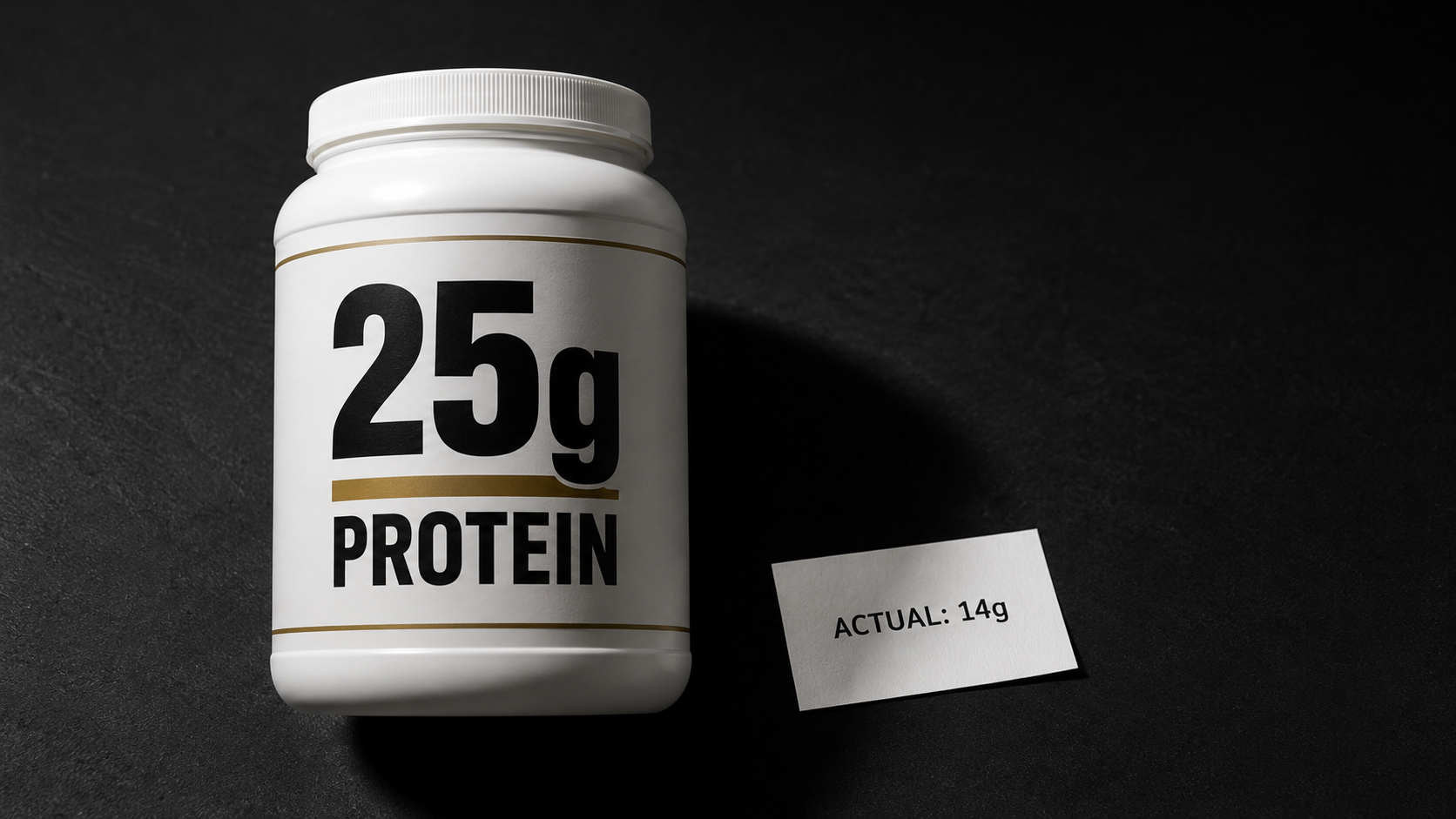
Label fraud in protein supplements means a product’s packaging overstates how much actual, muscle-building protein is delivered per serving. This happens through two main routes: including cheap non-protein ingredients that inflate the nitrogen count (called amino spiking or nitrogen spiking), or simply miscounting genuine protein content at the manufacturing stage. In both cases, you pay for protein you are not receiving.
How big is the problem in India?
India’s protein supplement market has crossed ₹6,000 crore in revenue and is still growing. More people than ever are buying whey protein. More people than ever are being shortchanged on what they paid for.
This is not speculation. In 2024, an independent peer-reviewed study bought 36 of the most popular protein supplements sold in India — across gyms, retail stores, and online platforms — sent them to an accredited lab, and published every raw data sheet publicly. The findings were uncomfortable.
From the Citizens Protein Project (Philips CA et al., Medicine, April 2024):
- Approximately 70% of the 36 brands tested overstated protein content or showed signs of amino spiking
- Some products delivered only 50% of the protein claimed on the label
- 75% of products contained detectable lead; 27.8% contained cadmium
Source: Philips CA, Theruvath AH, Ravindran R, Chopra P. Medicine (Baltimore). 2024;103(14):e37724. Peer-reviewed, open access, raw lab data publicly available.
Following this, in June 2024, FSSAI announced a crackdown on protein supplement brands making false and misleading claims. The study had done what regulators had not: bought products off the shelf, tested them, and published the results without any manufacturer involvement.
How amino spiking works — and why it is hard to detect
Standard protein testing measures total nitrogen in a sample and converts it to a protein figure using a mathematical formula (the Kjeldahl or Dumas method). The formula assumes all nitrogen in the sample comes from protein. It does not.
Cheap free-form amino acids also contain nitrogen:
- Glycine costs approximately ₹80 per kilogram
- Taurine costs approximately ₹150 per kilogram
- Complete whey protein isolate costs ₹800–₹1,200 per kilogram
A manufacturer who adds glycine or taurine instead of more whey still passes a standard nitrogen test. The label reads 25g protein. The customer receives 15–18g of actual, complete, muscle-building protein — plus cheap amino fillers that do not stimulate muscle protein synthesis.
Glycine and taurine are not among the essential amino acids your body needs for muscle repair and growth. They are, however, excellent at making a cheap product look expensive on paper.
What label fraud looks like in practice
| What You See on the Label | What It May Mean | Verdict |
|---|---|---|
| Glycine or taurine listed separately as ingredients (in a whey product) | Likely nitrogen spiking — these amino acids inflate the protein count without contributing to muscle synthesis | High concern |
| No amino acid profile disclosed anywhere | Brand is not showing what percentage of claimed protein is complete vs. filler amino acids | High concern |
| Price significantly below comparable products (under ₹2,000/kg) | May indicate cheaper raw materials, lower actual protein, or amino spiking | Investigate further |
| “Proprietary protein blend” without individual ingredient weights | You cannot verify what percentage of the blend is actual protein vs. cheaper fillers | High concern |
| No third-party lab certificate available on request | Protein content is self-reported by the manufacturer, not independently verified | High concern |
| Full amino acid profile published, no separate glycine or taurine line items | Label is likely accurate and protein is complete | Positive sign |
| Third-party certificate from NABL-accredited lab available publicly or on request | Protein content has been independently verified, not just self-reported | Positive sign |
How to read a protein supplement label in India — step by step
FSSAI-regulated supplement labels follow a specific format. Here is how to read one in sequence, rather than looking only at the large marketing number on the front of the tub.
Step 1 — Start with the nutrition facts table, not the front label
The large “25g Protein” text on the front is marketing. The nutrition facts table on the back is the legal disclosure. Go there first. Find the protein grams per serving and note the serving size in grams. Then calculate protein as a percentage of serving size. A genuine whey isolate should deliver 80–90g of protein per 100g of powder. If it delivers 60–65g per 100g, the remaining grams are carbohydrates, fillers, or non-protein amino acids.
Step 2 — Read the full ingredients list for amino spiking flags
Ingredients are listed in descending order of weight. If glycine, taurine, glutamine, or creatine appear as separate items in a whey protein product, ask why. Pure whey contains approximately 2–3% glycine naturally. A product listing glycine as a named ingredient almost certainly has more than that — and is counting it toward the protein figure.
Step 3 — Identify the exact protein source
The label must disclose what the protein actually is. “Whey protein concentrate,” “whey protein isolate,” “soy protein isolate,” and “milk protein” are acceptable disclosures. “Protein blend” without specifying components is not. Concentrate typically delivers 70–80% protein by weight; isolate delivers 90%+. If a concentrate-based product claims 90%+ protein per serving, that number deserves scrutiny.
Step 4 — Request the full amino acid profile
Any serious brand can produce a batch-specific amino acid profile from an accredited laboratory. This document shows the breakdown of all amino acids present. If the sum of listed amino acids roughly equals the total protein per serving, the label is accurate. If glycine or taurine numbers are disproportionately high relative to a natural whey protein profile, spiking is likely. If a brand refuses this request or cannot produce it, you have your answer.
Step 5 — Verify third-party testing separately from FSSAI registration
FSSAI certification means a brand has registered and submitted its own test results. It does not mean FSSAI independently tested the product before it went to market. Third-party testing from an NABL-accredited laboratory not affiliated with the brand is the only independent verification. Ask whether the brand publishes these certificates, and for which parameters. Protein content, full amino acid profile, and heavy metals are the minimum standard.
The FSSAI gap: registration is not the same as verification
A common assumption is that an FSSAI licence on a product means someone checked it. That is not how the system works.
At present, safety and content testing for protein supplements is the manufacturer’s responsibility. The brand tests its own product and submits those results as part of the registration process. FSSAI reviews the submission but does not independently test the product before it reaches shelves. Post-market surveillance exists but is reactive and selective. Most products go untested by any independent party from production to purchase.
The Citizens Protein Project existed precisely because no official body had done what an independent hepatologist and an entrepreneur did with their own funds: bought supplements off the shelf and sent them to a lab with zero manufacturer involvement.
FSSAI’s 2024 crackdown announcement is a step in the right direction. But until systematic, independent, post-market testing is routine rather than reactive, an FSSAI number on a label tells you a product is registered — not that it contains what it claims.
Frequently asked questions
Are protein supplements in India really underdosed — or is this overstated?
The data says it is real. The Citizens Protein Project, published in the peer-reviewed journal Medicine in April 2024, tested 36 popular protein supplements sold in India and found approximately 70% overstated their protein content or showed signs of amino spiking. Some products delivered only half the protein claimed on the label. This was independent lab testing with every raw data sheet published publicly. Full citation: Philips CA et al., Medicine (Baltimore), 2024;103(14):e37724.
What is amino spiking in protein supplements?
Amino spiking is the practice of adding cheap free-form amino acids such as glycine or taurine to a protein powder to inflate the protein count on paper. Standard protein testing measures total nitrogen, and these amino acids contain nitrogen too — so they artificially raise the reported protein figure. These amino acids do not build muscle. They are not essential, and they do not stimulate muscle protein synthesis.
How do I check if my protein powder is amino spiked?
Look at the full ingredients list. If glycine, taurine, glutamine, or creatine appear as separate line items in a whey protein product, this is a red flag. Pure whey protein contains roughly 2–3% glycine naturally. Ask the brand for a full amino acid profile from an accredited lab. A transparent brand will provide this without hesitation. If they cannot or will not, that is your answer.
Does FSSAI regulate protein supplement quality in India?
FSSAI regulates labelling and approves permitted ingredients. However, protein content testing is based on results submitted by the manufacturer and is not independently verified before a product goes to market. Post-market enforcement exists but is reactive, not systematic. In 2024, FSSAI announced a crackdown on misleading claims following independent research that exposed widespread label inaccuracies. Registration and enforcement are different things.
What should a trustworthy protein label include?
A trustworthy label discloses: the exact protein source (e.g., whey protein isolate vs. concentrate), the protein per 100g of powder — not just per serving, the complete amino acid profile, no proprietary blends obscuring individual ingredient weights, and the name of the independent NABL-accredited lab that verified the batch. If any of these are missing, the brand is asking for trust it has not earned.
Is a higher price a guarantee of better protein quality?
No. The Citizens Protein Project found quality problems across price points, not only in budget products. Price is an imperfect proxy. The real indicators are third-party lab testing, a transparent amino acid profile, and disclosed ingredient sources. A brand that publishes its certificates unprompted is more trustworthy than one that charges a premium and says nothing about how its product was verified.
A note from Just What Works™
JWW does not sell protein supplements. But the same dynamics that produce underdosed protein tubs — opaque sourcing, nitrogen math exploits, no third-party verification — appear across the broader supplement industry. It is the reason we built around three non-negotiables: every active ingredient is disclosed individually with its exact dose, every compound is tested by an independent NABL-accredited lab, and every batch certificate is available to anyone who asks.
We call this Radical Transparency. It is not a marketing term. It is the minimum standard we hold ourselves to — because we spent long enough watching the alternative.
If a brand cannot show you who made it, what dose you are actually getting, and which independent lab confirmed that… you are not buying a supplement. You are buying a label.
The supplement you trust with your biology deserves the same scrutiny you would give anything else you put in your body. The data to make that call exists. Most brands are just hoping you will not look for it.
What would make you switch protein brands — the data, the price, or the brand story?
Last reviewed: May 2025 | Author: Abhishek Singhh, Founder, Just What Works™ (Elara Biosciences Pvt. Ltd.) | Primary source: Citizens Protein Project, Medicine (Baltimore), 2024

Abhishek Singh is the founder of Just What Works and a passionate entrepreneur in the nutraceutical space. Through his brand and writing, he shares practical business strategies, wellness insights, and real-world lessons from his own startup journey. His work helps readers cut through noise and focus on building businesses — and lives — that truly work.